The Data
 Both tables come from the ATP
Tour Leaderboards, using the 52-week rolling window across all surfaces, retrieved
September 2026. The serve table is sorted by Serve Rating and the return table by
Return Rating — both are ATP composite scores, not raw stats.
One thing to know before you start: the two ratings run on different scales. Serve Ratings sit near 300, Return Ratings near 160. You cannot add them together to get an overall score. To compare a player across both halves of the game you have to compare their ranks, not their ratings — which is exactly what the summary box below does.
| # | Player | Serve Rating A measure of overall serving performance. A higher Serve Rating means the player is generally more effective on serve. |
% 1st Serve The percentage of first serves that land in. A higher percentage helps a player avoid second-serve situations. |
% 1st Serve Points Won The percentage of points won when the player's first serve goes in. Shows how effective the first serve is. |
% 2nd Serve Points Won The percentage of points won on the second serve. The most revealing serve stat, because the second serve is the shot a player can't hide. |
% Service Games Won The percentage of service games a player wins. This is what a great serve is ultimately for, and it tracks Serve Rating closely. |
Avg. Aces / Match The average number of aces a player hits per match. Spectacular, but a weak predictor of Serve Rating. |
Avg. Double Faults / Match The average number of double faults per match. Fewer double faults means fewer free points given away. |
|---|---|---|---|---|---|---|---|---|
| 1 | 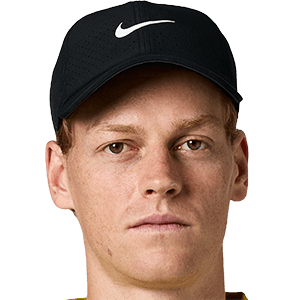 Jannik Sinner |
305.3 | 65.4% | 80.7% | 58.4% | 93.5% | 8.6 | 1.3 |
| 2 |  Ben Shelton |
299.4 | 68.3% | 76.5% | 57.5% | 89.9% | 10.0 | 2.8 |
| 3 | 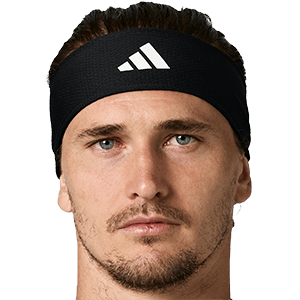 Alexander Zverev |
299.3 | 71.8% | 76.0% | 56.0% | 88.5% | 9.2 | 2.2 |
| 4 |  Taylor Fritz |
298.9 | 65.7% | 79.2% | 53.2% | 88.9% | 13.9 | 2.0 |
| 5 |  Giovanni Mpetshi Perricard |
297.0 | 71.2% | 76.7% | 49.5% | 86.9% | 15.9 | 3.2 |
| 6 |  Hubert Hurkacz |
294.8 | 63.3% | 79.6% | 50.6% | 88.5% | 15.7 | 2.9 |
| 7 |  Felix Auger-Aliassime |
294.2 | 67.6% | 78.1% | 51.6% | 88.8% | 10.8 | 2.7 |
| 8 |  Brandon Nakashima |
289.6 | 65.8% | 77.6% | 50.3% | 87.0% | 9.9 | 1.0 |
| 9 |  Alexander Bublik |
289.5 | 64.8% | 78.3% | 50.5% | 87.5% | 11.9 | 3.5 |
| 10 |  Arthur Rinderknech |
289.0 | 63.5% | 77.2% | 51.9% | 87.3% | 12.0 | 2.9 |
| # | Player | Return Rating A measure of overall return performance. A higher rating means stronger performance when returning an opponent's serve. |
% 1st Serve Return Points Won The percentage of points won when returning an opponent's first serve. Shows how effective a player is against big first serves. |
% 2nd Serve Return Points Won The percentage of points won when returning an opponent's second serve. This is where returners do most of their damage. |
% Return Games Won The percentage of an opponent's service games a player wins. This is what a great return game is for, and it tracks Return Rating closely. |
% Break Points Converted The percentage of break-point opportunities converted into a break of serve. Dramatic, but a weak predictor of Return Rating. |
|---|---|---|---|---|---|---|
| 1 | 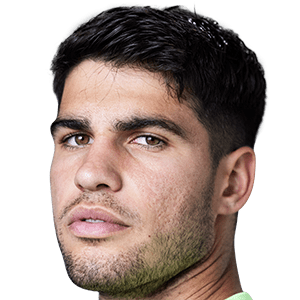 Carlos Alcaraz |
160.6 | 34.4% | 53.5% | 30.0% | 42.7% |
| 2 |  Daniel Merida |
160.5 | 32.0% | 54.1% | 29.6% | 44.8% |
| 3 | Jannik Sinner |
159.2 | 33.4% | 54.6% | 29.9% | 41.3% |
| 4 |  Rafael Jodar |
158.6 | 33.1% | 51.8% | 29.7% | 44.0% |
| 5 | 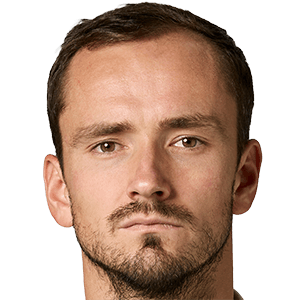 Daniil Medvedev |
158.5 | 34.0% | 53.4% | 28.3% | 42.8% |
| 6 |  Luca Van Assche |
155.2 | 31.3% | 52.9% | 28.4% | 42.6% |
| 7 |  Francisco Cerundolo |
154.5 | 31.7% | 53.4% | 29.4% | 40.0% |
| 8 |  Learner Tien |
153.2 | 31.1% | 52.9% | 26.3% | 42.9% |
| 9 |  Alex de Minaur |
152.5 | 31.2% | 53.9% | 26.4% | 41.0% |
| 10 |  Ignacio Buse |
152.3 | 30.6% | 50.3% | 25.5% | 45.9% |
Player Breakdown
Click any player's name in either table above. Their row lights up, and if they appear on both leaderboards the second table lights up too. Watch what usually happens: only one table responds. Of the nineteen players across these two lists, exactly one shows up on both — and that absence is the most useful thing this page can show you.
Click a player's name in either table to see their profile here.
What the Data Tells Us
Only one player is elite at both
Jannik Sinner is No. 1 on serve and No. 3 on return. Nobody else on either list appears on the other one. Eighteen of nineteen players here are specialists — elite on one side of the ball and unranked on the other. Being complete isn't the standard at the top of tennis; it's a rounding error.
In both tables, the famous stat lies
Aces don't rank a server. Mpetshi Perricard hits 15.9 a match and sits 5th; Hurkacz hits 15.7 and sits 6th; Sinner hits 8.6 and sits 1st. What actually tracks Serve Rating is Service Games Won, which descends almost perfectly down the table — 93.5, 89.9, 88.9, 88.8, 88.5.
The return table does the same thing. Ignacio Buse converts more break points than anyone here (45.9%) and ranks 10th of 10, because he wins the fewest return games (25.5%). Francisco Cerundolo converts the fewest (40.0%) and ranks 7th, because he breaks in 29.4% of games. Holding and breaking are what matter. Aces and break-point conversion are what get on television.
Great servers are famous; great returners aren't
Every name in the serve top 10 is one a casual fan would recognize. Half the return top 10 — Merida, Jodar, Van Assche, Tien, Buse — are players most fans have never heard of. A serve gets you ranked, seeded, and televised. A return game gets you a leaderboard entry.
Same rating, opposite engines
Shelton (299.4) and Zverev (299.3) are a tenth of a point apart and get there completely differently. Zverev lands 71.8% of first serves and gives away 2.2 double faults; Shelton lands 68.3% and gives away 2.8, but wins 57.5% of second-serve points, second-best on the board. One is built on accuracy, the other on damage. They met in the US Open final and the accuracy won.
Where that leaves Shelton
He is the No. 2 server in the world and he does not appear on the return leaderboard at all. That is the most lopsided profile on this page. The serve is what got him to a Grand Slam final, and the missing column is why his matches run four hours and end in tiebreaks — and why he was the runner-up.